FCI Standard No. 139 – Irish Terrier
General Appearance:
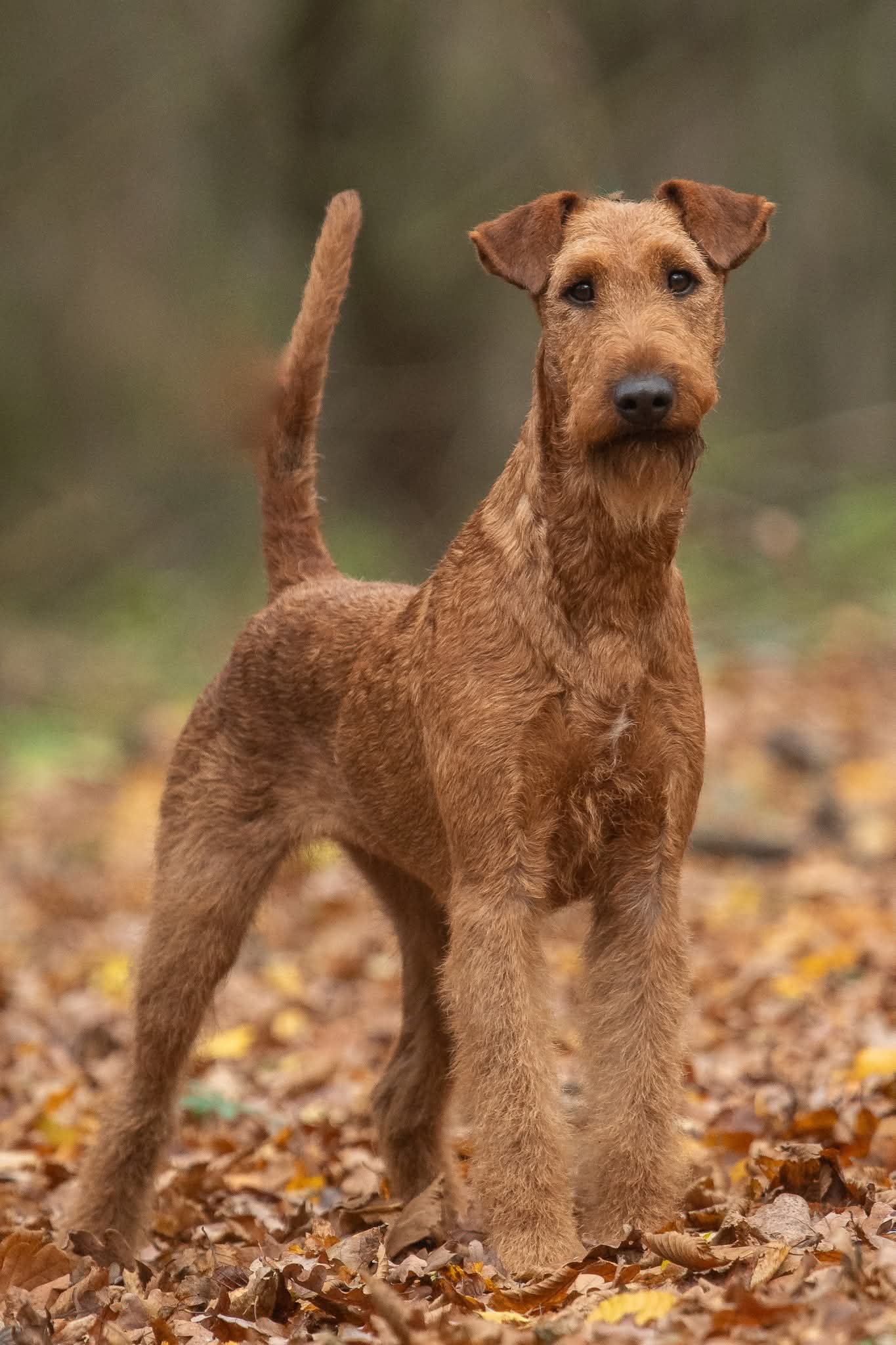
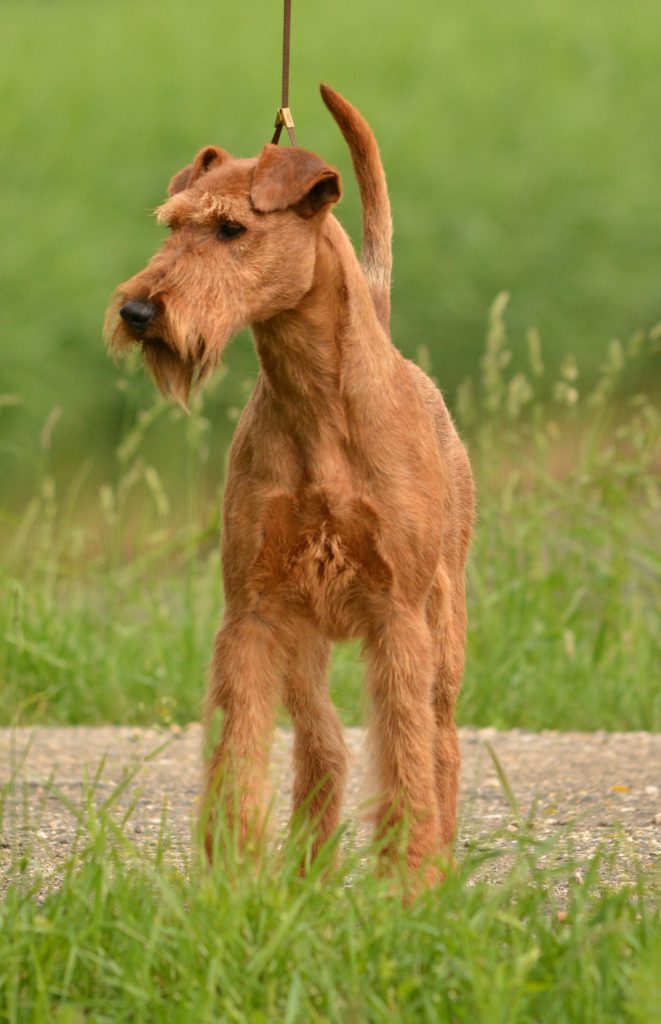
The Irish Terrier is an active, lively, and wiry-coated dog of good substance, without being clumsy, as speed, endurance, and power are of essential importance to the breed. It must be neither clumsy nor cobby. Its outline and form express speed, grace, and agility.
Behaviour/Character:
Although spirited and capable of holding its own against other dogs, it is remarkably loyal, good-natured, and affectionate toward humans. When attacked, it fights with the courage of a lion to the very end.
Head:
Long and free from wrinkles.
Cranial Region:
Skull flat and rather narrow between the ears, tapering slightly towards the eyes.
Stop:
Hardly visible except in profile.
Nose:
Must be black.
Lips:
Tight, almost black externally.
Jaws:
Jaws strong and well-muscled, of sufficient length to allow a good grip.
Teeth:
Strong, evenly placed, clean and healthy; upper incisors slightly overlapping the lower incisors in a scissor bite.
Cheeks:
Not too full. Slightly hollowed under the eyes so that the head does not resemble that of a Greyhound.
Eyes:
Dark, small, not protruding, full of life, fire, and intelligence. Yellow or light-coloured eyes are highly undesirable.
Ears:
Small, V-shaped, moderately thick, set on well, and falling forward closely against the cheeks. The top line of the folded ear is well above the level of the skull. Hound-like ears hanging at the side of the head are not typical of the breed; semi-erect ears are even less desirable. The ears are covered with short hair, darker in colour than that of the body.
Neck:
Of considerable length, gradually widening towards the shoulders. Carried proudly and free from throatiness. A slight collar of longer hair is usually present, extending almost to the ear set.
Body:
Well balanced, neither too long nor too short.
Back:
Strong and straight, with no sign of slackness behind the shoulders.
Loin:
Muscular and very slightly arched. In females, the loin may be slightly longer than in males.
Chest:
Deep and muscular, but not overly broad or wide, with well-sprung ribs. Rather deep than round; ribs well carried back.
Tail:
Set on rather high and carried gaily, but not curled over the back or ringed. Of good strength and substance and fairly long. Customarily docked to about three-quarters of its length; however, a natural undocked tail is also permitted. Covered with coarse hair, free from feathering or flagging.
Limbs:
The movement of both fore and hind limbs is directed straight forward.
Forequarters:
Limbs of moderate length, well placed under the shoulders, perfectly straight with strong bone and musculature.
Shoulders:
Clean-cut, long, and well laid back.
Elbows:
Working freely close to the body.
Pasterns:
Short and straight, barely perceptible at the base.
Hindquarters:
Strong and muscular.
Thighs:
Powerful.
Stifle (Knee):
Moderately angulated, not turning in or out.
Hock:
Set low above the ground.
Feet:
Strong, fairly round, and moderately small. Toes arched, neither turned in nor out. Black nails are highly desirable. Pads firm, free from cracks or excrescences, and adapted for work.
Gait/Movement:
Fore and hind limbs move straight and parallel forward. Elbows move parallel to the body and work freely at its sides. Stifles neither turn in nor out.
Coat:
Dense and wiry, broken-coated in appearance, yet lying flat to the body. The individual hairs are strong and grow closely together so that the skin cannot be seen when the coat is parted with the fingers. The coat must not be silky or soft, particularly on the hindquarters. It must not be so long as to obscure the outline of the body, and must not be curly or wavy. The hair on the muzzle is of the same texture as on the body, only shorter (about 6 mm), almost smooth and straight. A fine beard is the only permissible longer hair (long only in relation to the rest of the coat) and is a characteristic of the breed. A “goat beard” indicates a silky, incorrect coat over the entire body. The limbs are not furnished with feathering, and like the head are covered with the same hard but not as long coat as the body.
Colour:
The dog must be of a uniform colour; most desirable are bright red, red-wheaten, or yellowish-red. White may occasionally appear on the chest and feet, but is more objectionable on the feet than on the chest, as it occurs more commonly in all solid-coloured breeds.
Height:
Approximately 18 inches (45 cm).
Weight:
Males: 12.25 kg
Females: 11.4 kg
Despite the desired weight indicated above, this characteristic is a matter of overall appearance. Dogs that are undersized or oversized can be easily identified in the show ring regardless of weight. Actual weight must never become a decisive factor at the expense of type and balance, otherwise an incorrect type may be favoured. For example, a small, heavy-set, coarse dog—although undesirable—may fall within the ideal weight, just as a long-legged, light-framed, whippet-like dog may also fall within or below the ideal weight. This demonstrates that while the standard weight should not be ignored, it must not be decisive in judging. The determining factor should be an overall acceptable size combined with the other required characteristics.
Faults:
Any deviation from the above points should be considered a fault, and the seriousness with which it is regarded should be in exact proportion to its degree and its impact on the dog’s working ability.
Disqualifying Faults:
Nose: Any colour other than black.
Bite: Pronounced overbite or underbite.
Colour: Any colour other than red, red-wheaten, or yellowish-red. A small white patch on the chest, as in all solid-coloured breeds, is permitted.
Feet: Severe growths or defects on the footpads.
Note:
Males must have two apparently normal testicles fully descended into the scrotum.
Character and Appearance – A Brilliant Dog in a Glowing Red Coat
"A dog made of gold. Inside and out.” This is how Jack London described the breed in his two world-famous novels, Jerry of the Islands and Michael, Brother of Jerry. He vividly presents through the adventurous stories of Michael and Jerry all the traits that characterize the breed.
At the time, the breed was developed to accompany its owner in everyday life, to guard the homestead, and to keep farmyards free of vermin. The result was a remarkably versatile terrier, one that lives in an exceptionally close partnership with its owner. Its greatest desire is simply to be near its human at all times. When raised correctly, it never turns into intrusive behaviour, hyperactive jumping, or constant climbing into laps. It is quite enough for the dog to rest its head on its owner’s leg, or gently place a paw on a foot -and it is already at peace, quietly closing its eyes.
With its red coat, natural elegance, and radiantly intelligent eyes, it easily draws people’s attention. A loyal and devoted companion, it is versatile, quick to learn, and an exceptionally intelligent working and sporting dog. At the same time, it must not be forgotten that despite its many excellent qualities, it is also a self-aware, energetic, and often willful terrier. It requires consistent training, but does not tolerate harshness -with forceful handling, no results can be achieved. Life with an Irish Terrier is never boring, and a sense of humour is certainly an advantage for its owner. It reacts remarkably quickly to its owner’s mood and is perfectly able to assess what is needed in order to please them. It also makes excellent use of its innate charm when it has done something wrong or simply wishes to cheer up its owner. Every Irish Terrier owner knows this situation well: head resting on a lap, wide, shining eyes, and a slow, cautious wag of the tail.
As the 19th-century author Albert Payson Terhune wrote: “The Irish Terrier is perhaps the finest dog on earth. He has a heart three sizes too big for his shaggy body; a heart that is as white & clean as that of a knight-errant. He is no bully, but will flinch not one hundredth of an inch from the fight that is forced upon him, be the odds ever so impossible against him. There is a psychic side of the Irish Terrier, too, found in almost no other dog - a touch of the mysticism of the land of his ancestry.” … “He does not throw away his priceless devotion and loyalty on every stranger who may chirp to him, but to the death, he is the comrade, protector, and exuberant playmate and sympathizing comforter of the human who has won his heart and respect. He is an Irish gentleman from the deathless old school."
Appearance
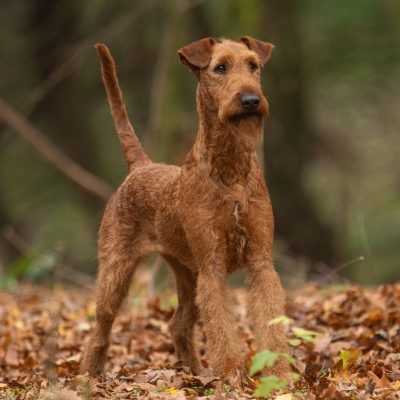
The Irish Terrier is a medium-sized breed belonging to the long-legged terrier group. It is small enough to fit comfortably in a car, making it an ideal travelling companion, yet large enough to defend its home and owner when necessary. The overall impression characteristic of the breed is defined by the combination of its conformation, temperament, and movement.
According to the standard, the Irish Terrier is an active, lively dog with a keen expression and a well-balanced, athletic build. Its physique conveys speed, strength, and endurance. Individuals of the breed must possess well-developed musculature, sound bone, and structural strength, while at the same time maintaining elegance. This is, indeed, not such an easy balance to achieve.
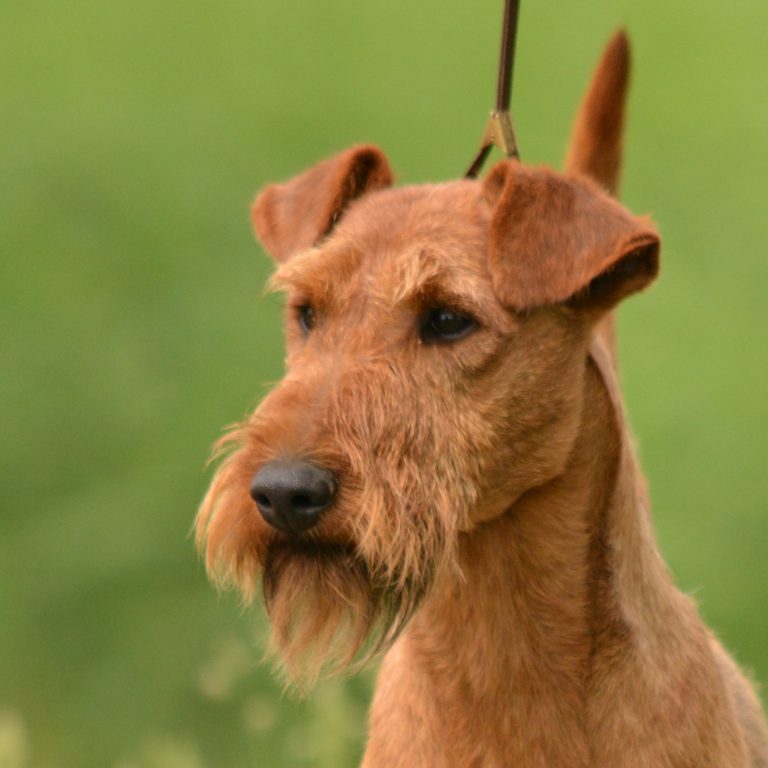
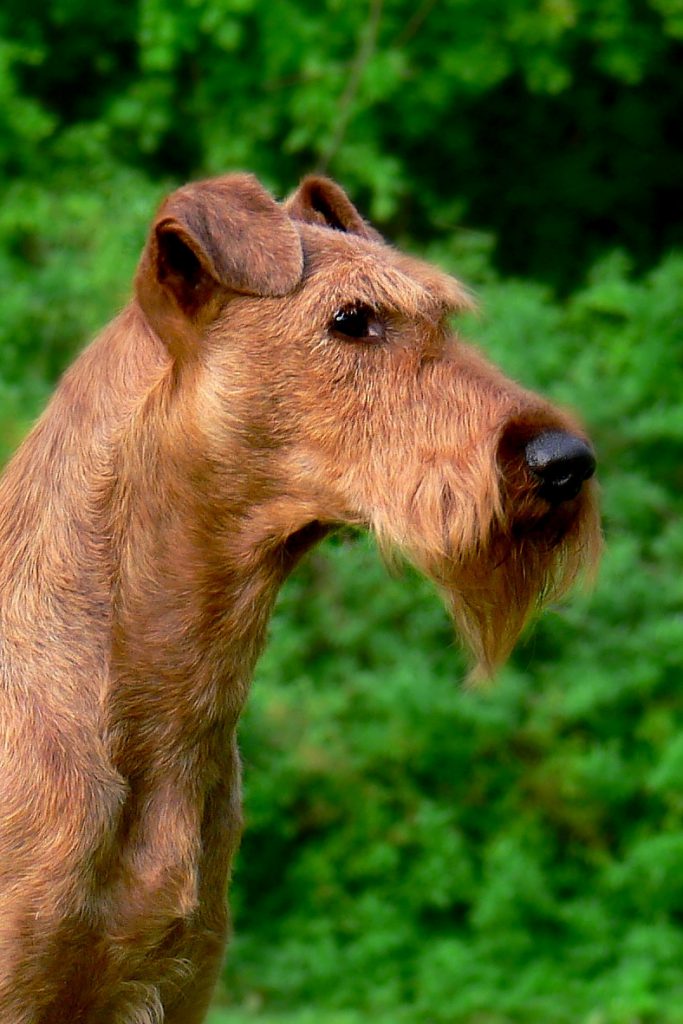
The characteristic Irish Terrier presence, expressing determination, self-confidence, cheerfulness, courage, and nobility at the same time, is defined primarily by the eyes, ears, and the coat on the head. The eyes are dark, small, set deep, and almond-shaped, with well-pigmented brown eyelids. The ears are set high, small, V-shaped, and folding forward, with the tips pointing toward the level of the outer corner of the eye, i.e. set noticeably lower than in Fox Terriers. The coat on the ears is slightly darker than on the rest of the body. The ears are highly expressive, from their movement one can clearly read the dog’s emotional state. An important role in the breed’s characteristic expression is played by the correct length and texture of the eyebrows and beard, as well as by whether the dog is trimmed by a groomer or breeder who understands the precise trimming technique required for these areas.
The typical Irish Terrier head shape can be compared to a brick, with particular importance placed on parallel planes and correct proportions. The ratio between the cranial and facial regions must be exactly 1:1. The nose must in all cases be black.
The neck is of medium length and elegant. Correct shoulder angulation is essential for the breed’s characteristic, free movement. The chest is deep and muscular, with its deepest point reaching the level of the elbow joint. The ribcage must not be broad or barrel-shaped. The loin is muscular and slightly arched, which is an important breed characteristic.
The hindquarters are the driving power of the body, with well-muscled thighs and moderate stifle angulation and good hock angulation.
The tail is set on high, carried straight or in a sabre-like curve, but in no case curled over the back.
The Irish Terrier is a wire-coated breed with a suitable amount of undercoat. The coat should follow the outline of the body, but ideally it should not present a smooth surface as in the smooth-coated fox terrier. When an Irish Terrier is in a longer coat, the texture is often slightly wavy in most coat types. When trimmed short, this waviness often disappears, resulting in a smoother overall impression. Coat colour is accepted from wheaten to dark red, with no shade being preferred over another. An important factor is that the coat must have the correct harsh texture, with appropriate quality and length of covering on the head and legs.
Overall, it can be said that the breed’s appearance is more or less clearly defined by the breed standard. The most important aspect is a harmonious overall impression, in which the head and the dog’s correct, well-balanced proportions are the key factors.
For decades, breeders of the breed have debated issues of weight and size. The standard specifies a shoulder height of 45.5 cm for both males and females; however, this is no longer considered realistic today. In 1988, the standard was therefore supplemented with a detailed explanation regarding weight and height, and a consensus was reached that the most important factor is the overall impression. In other words, a slightly larger dog with ideal proportions and a correct breed type is far more desirable than a dog of standard height and weight but lacking balance and correct structure. Today, the average shoulder height is generally 46–48 cm for females and 48–50 cm for males. Body weight should be in harmony with the overall appearance, typically ranging between 14.5 and 17 kg.
Individuals with a very dark red or dark brown coat and an extremely harsh texture occasionally appear. For many, this creates a more visually appealing and desirable impression than a lighter wheaten Irish Terrier. However, it should be noted that an excessively dark colour on the head already gives the Irish Terrier a completely different expression than is considered desirable. Such coats are often easy to trim, and therefore this type is preferred by some breeders as a breeding objective. Unfortunately, however, this coat texture often results in insufficient coverage on the head and limbs. According to the standard, correct leg coat, as well as the eyebrows and beard that strongly define the characteristic Irish Terrier expression, are essential breed features. In dogs with this coat type, these are often missing or insufficient, which constitutes a serious fault. In this breed, colour must not be considered a determining factor of value.
Health
- from a Veterinarian’s Perspective
An elegant appearance reflects sound anatomy and a healthy constitution. Hereditary diseases that are so commonly seen in fashionable breeds are rare in this breed. Hip and elbow dysplasia, bite abnormalities, hernias, cryptorchidism, patellar luxation, and inherited eye or heart diseases are not typically encountered. This can partly be attributed to the balanced body structure and the absence of anatomical extremes that are present in many other breeds (such as bulldogs and other brachycephalic dogs). Furthermore, it can be said that the breed has avoided “fashion waves”; despite having many admirers, it has never become a victim of popularity. Its breeders have carried out, and continue to carry out, their work conscientiously and with expertise.
They are a robust breed, generally long-lived, although this is not always the case in certain American lines. In order for this genetically sound predisposition to result in genuinely healthy dogs, proper nutrition, vaccination, and parasite control play an essential role. At this point, it is also worth mentioning the neutering of dogs not intended for breeding, which can be of particular importance in females. Early-age neutering significantly reduces the risk of mammary tumours and pyometra, both of which are common conditions. Of course, so-called lifestyle-related diseases, such as obesity and dental tartar, also affect Irish Terriers, and these issues must be managed with appropriate care and attention.
Ideally, Irish Terriers have deeply set “terrier eyes.” To a certain extent, this may predispose them to conjunctivitis, as in deep-set eyes the conjunctival sac can more easily accumulate dust and other particles. In some dogs, a greyish-white discharge may collect in the inner corner of the eye by morning; however, this does not indicate that the eye is diseased.
At present, two hereditary diseases are known in the breed.
Hyperkeratosis in Irish Terriers (Corny Feet, CF) is inherited in an autosomal recessive manner, which means that only dogs that have received the affected gene from both parents and carry the disease in a homozygous recessive form can be clinically affected.
Let us review the three genetically possible combinations in order to better understand the background of these conditions in the following sections.
- Version: Homozygous dominant individuals do not carry any copy of the disease allele; they are healthy and do not pass on the problem.
- Version: Heterozygous individuals carry one normal and one mutated (disease) allele. They do not show clinical symptoms and are healthy, but they are carriers of the disease. This is why, when two clinically healthy parents are both heterozygous carriers of the mutation, there is a 1/4 probability that affected offspring will be born.
- Version: Homozygous recessive individuals have inherited two copies of the disease allele. They are clinically affected, and their strict exclusion from breeding is strongly recommended.
Hyperkeratosis is a condition present in several terrier breeds, characterized by excessive keratinization of the paw pads and, in some cases, the nasal planum. The skin of the paw pads becomes thickened and cracked, and the structure of the claws may also be affected, leading to abnormally increased growth in length. Fortunately, the condition is not life-threatening, but it is uncomfortable and requires either intermittent or lifelong management. Affected dogs are not suitable for sporting or working purposes, as their paws become sensitive and prone to injury. The condition can be identified at an early age, typically from around seven months. The good news is that, after many years of research and anticipation, a DNA test for hyperkeratosis screening in Irish Terriers has become available. We are particularly proud to have contributed to the research work of the French Antagene laboratory by providing blood samples from 25 dogs originating from our kennel. All of our current breeding dogs have, of course, been tested and are clear. In practical terms, this means that among puppies born in our kennel, there can be no affected or carrier individuals of hyperkeratosis with certainty.
Cystinuria refers to the formation of cystine-containing urinary stones in the bladder. These calculi are the result of a metabolic disorder, the essence of which is an abnormal renal transport of the amino acid cystine.
Hereditary cystinuria occurs in many breeds, but not with an identical genetic background or clinical presentation. In Newfoundland dogs, for example, the condition is inherited in an autosomal recessive manner, and a genetic test has been available for many years to screen breeding animals. In the Irish Terrier, however, it is becoming increasingly clear that the inheritance pattern and clinical manifestation of the disease are not as straightforward.
In Irish Terriers, only males are affected by the disease, and castration appears to provide a definitive solution and clinical resolution for the individual. Research is currently ongoing in Germany, led by an Irish Terrier owner and veterinarian. At present, no genetic test is available. It has, however, been noted that genetically affected males, under conditions of adequate water intake and a reduced protein diet, may never develop clinical signs. In contrast, an increased protein intake may lead to stone formation even at a younger age.
Our kennel has been awarded, and is entitled to use, the 100% CF-free plaque issued by the German Terrier Club (Klub für Terrier), an achievement of which we are very proud.