
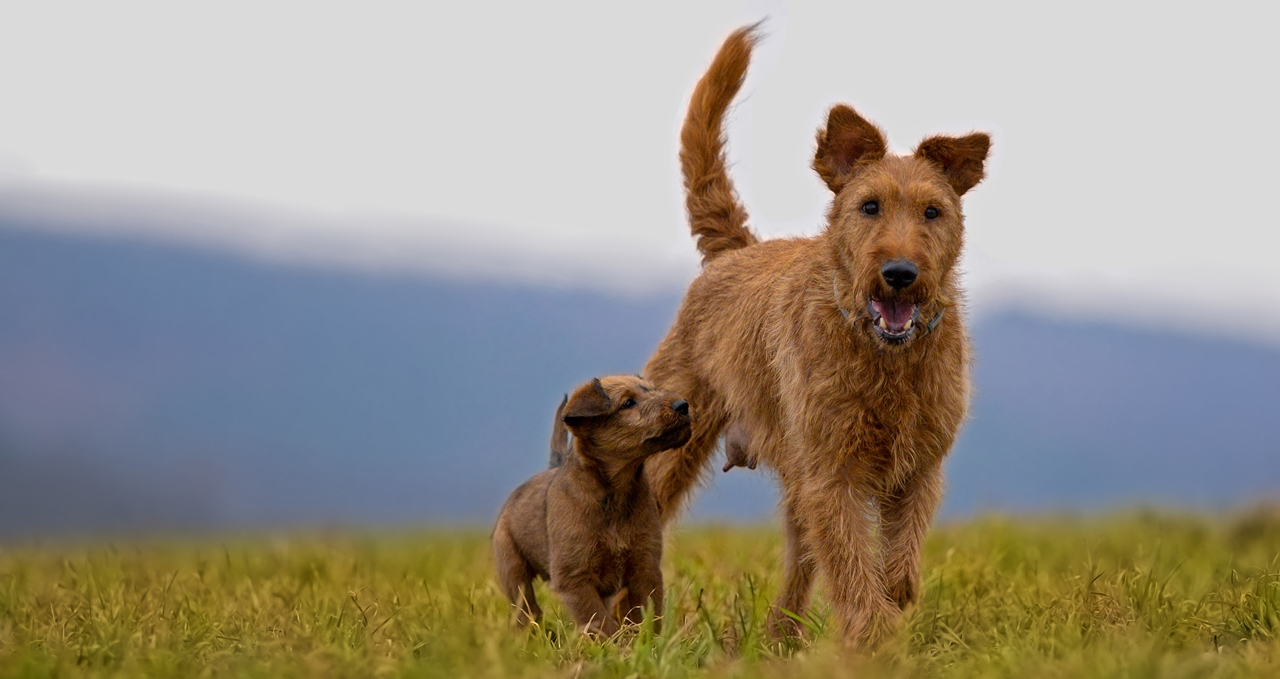
FCI-Standard N° 139 Irish Terrier
General Appearance
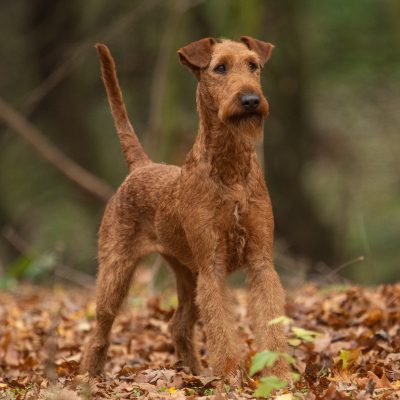
The Irish Terrier is an active, alert, and athletic dog with a wiry coat and well-balanced substance, combining speed, stamina, and strength without any hint of clumsiness. Its outline and overall shape convey agility, elegance, and readiness for action.
Temperament / Character
Although determined and capable of standing its ground against other dogs, the Irish Terrier is remarkably loyal, kind-natured, and affectionate toward humans. When challenged, it displays the courage of a lion and will defend itself with unwavering bravery.
Head
Long, free from wrinkles.
Skull
Flat and fairly narrow between the ears, tapering slightly toward the eyes.
Stop
Barely noticeable, except in profile.
Nose
Must be black.
Lips
Tight and almost black on the outside.
Jaws
Strong, well-muscled, and of sufficient length to ensure a firm grip.
Teeth
Strong, evenly spaced, clean, and healthy, with the upper incisors slightly overlapping the lower ones.
Muzzle
Not overly filled; slightly sloping under the eyes so that the head does not resemble that of a Sighthound.
Eyes
Dark, small, not prominent, full of life, fire, and intelligence. Yellow or light-colored eyes are highly undesirable.
Ears
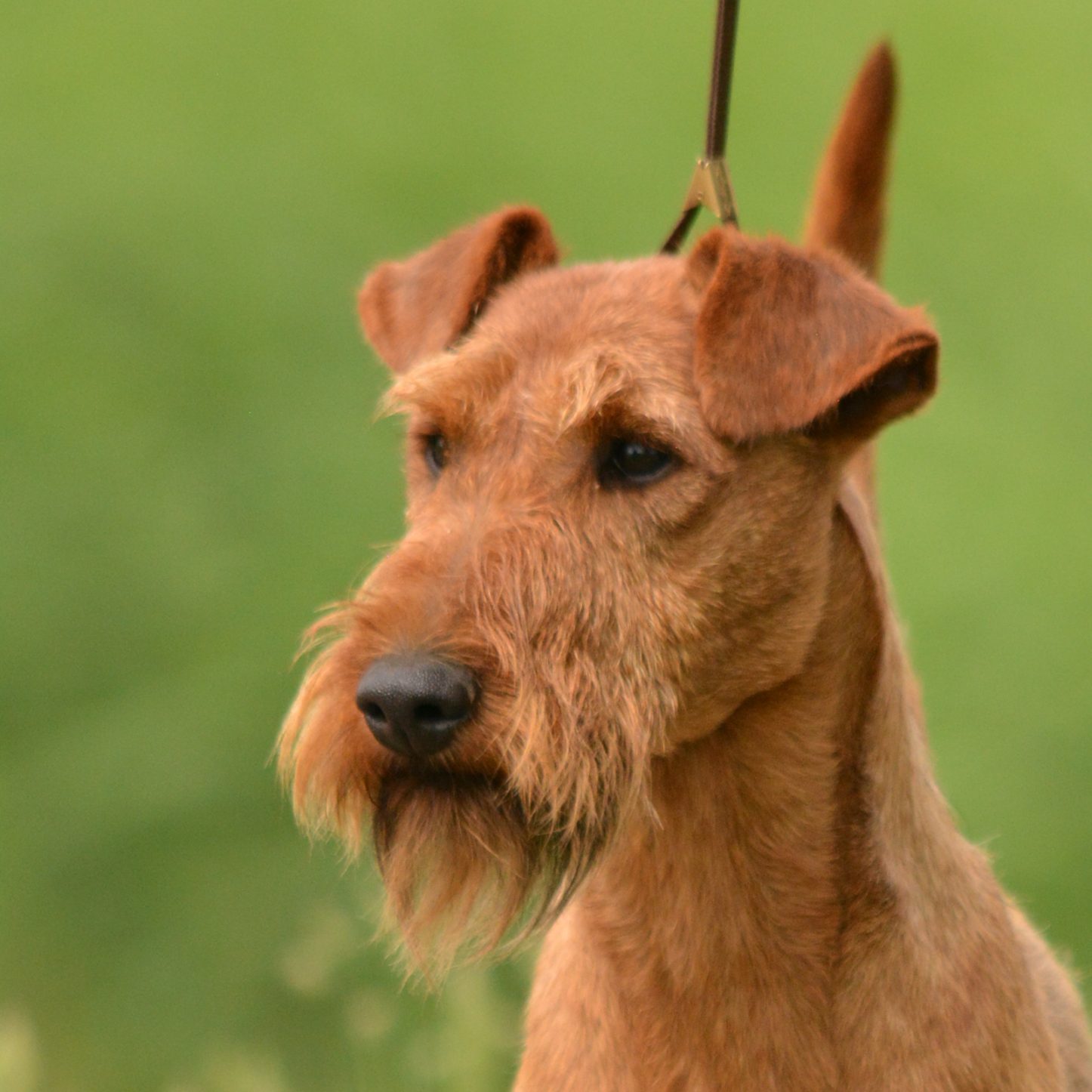
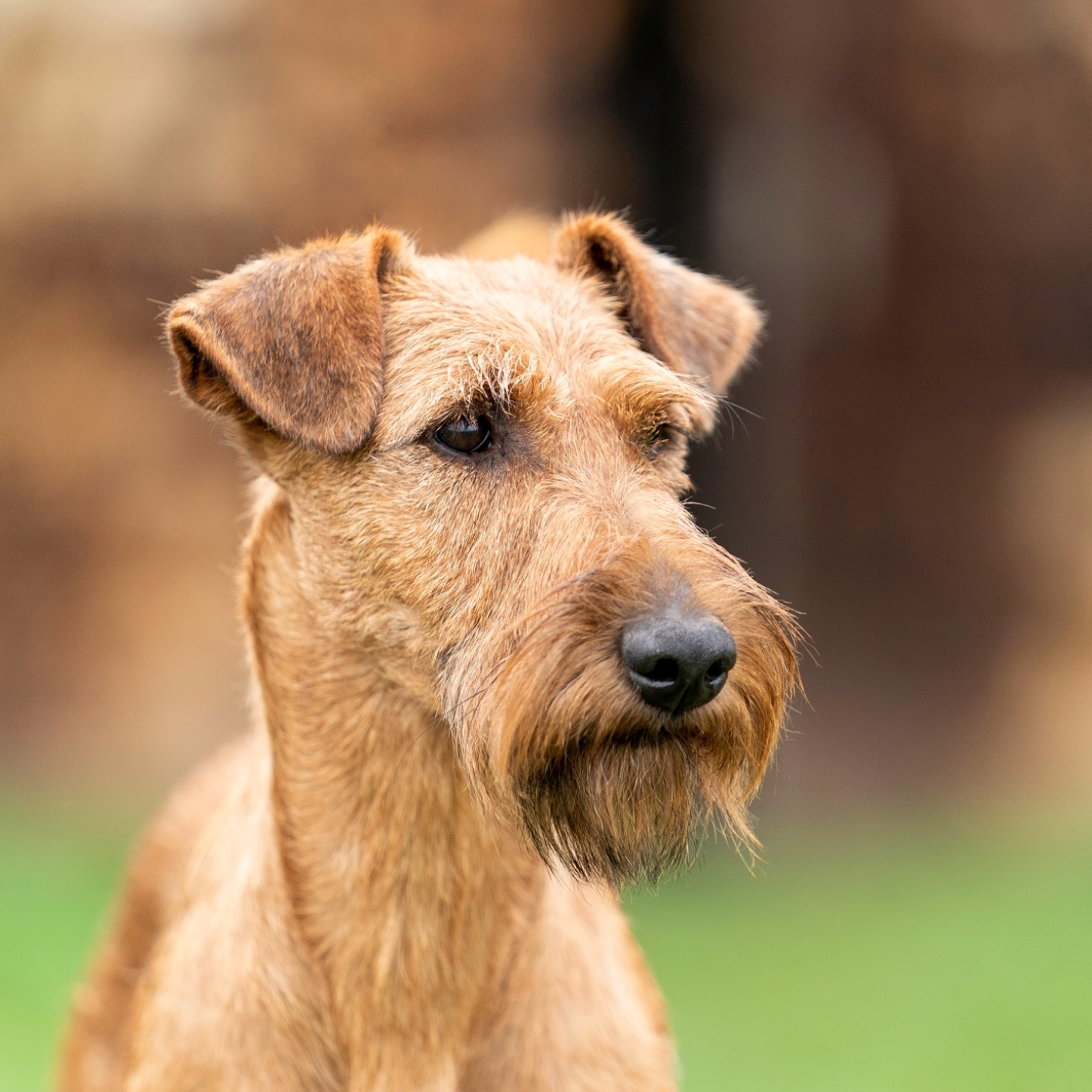
Small, V-shaped, moderately thick, set well on, and carried forward close to the cheeks. The top line of the folded ear sits well above the skull. Hound-like ears hanging flat to the sides are uncharacteristic of the breed, while semi-erect ears are even less desirable. The ears are covered with short hair, darker in shade than the body coat.
Neck
Of good length, gradually widening toward the shoulders, well carried and free from looseness. A slight ruff is often present on both sides, extending nearly to the ear set.
Body
Well balanced, neither too long nor too short.
Back
Strong and level, with no sign of slackness behind the shoulders.
Loin
Muscular and slightly arched. Females may have a slightly longer loin than males.
Chest
Deep and muscular, not broad or barrel-shaped, with well-sprung ribs carried well back. Deeper rather than round.
Tail
Set on fairly high and carried gaily, but never curled over the back or ringed. Strong, of good substance, and of moderate length. Traditionally docked to about three-quarters of its length, though a natural, undocked tail is permitted. Covered with harsh hair free from feathering.
Forequarters
Moderately long, set well under the shoulders, perfectly straight, with strong bone and muscle.
Shoulders
Clearly outlined, long, and set at a slant.
Elbows
Working freely and close to the body.
Hindquarters
Strong and muscular.
Thighs
Powerful.
Stifles
Moderately angulated, turning neither in nor out.
Hocks
Set low above the ground.
Feet
Strong, fairly round, and moderately small. Toes arched and turning neither inward nor outward. Black nails are highly desirable. Pads sound, free from cracks or growths, and fit for work.
Movement
Fore and hind legs move straight and parallel. Elbows move freely along the sides of the body. Stifles turn neither inward nor outward.
Coat
Dense, harsh, wiry, and broken in appearance, yet lying close to the body. Individual hairs are strong and closely set, concealing the skin even when parted by hand. The coat must never be silky or soft, especially on the hindquarters, nor so long as to obscure the body outline. It should not be curly or wavy. Facial hair is similar in texture to the body coat but shorter (approx. 6 mm), almost smooth and straight. A fine beard is the only permitted longer hair and is a characteristic feature of the breed. A silky “goat beard” indicates poor coat quality throughout. Legs are free from feathering and covered with harsh hair, shorter than that on the body.
Colour
The coat should be solid in colour, with bright red, red wheaten, or yellowish red preferred. White may occasionally appear on the chest and, less desirably, on the feet, as is common in many solid-coloured breeds.
Height at the withers
Approximately 18 inches (45 cm).
Weight
Males approx. 12.25 kg, females approx. 11.4 kg.
Despite these guidelines, weight must never be judged in isolation. Overall balance and type are of greater importance. A small, heavy, coarse dog or a light, leggy, whippet-like dog may both meet the desired weight yet remain undesirable. The decisive factor is a generally acceptable size combined with correct proportions and breed characteristics.
Faults
Any deviation from the foregoing points should be considered a fault, the seriousness of which depends on the degree of deviation and its effect on the health and welfare of the dog.
Disqualifying Faults
- Nose: any colour other than black
- Bite: pronounced over- or undershot bite
- Colour: any colour other than red, red wheaten, or yellowish red (a small white mark on the chest is permitted)
- Feet: cracked pads or abnormal growths
Note
Male dogs must have two apparently normal testicles fully descended into the scrotum.
Character
A radiant dog in a red coat
“A dog made of gold, inside and out.”
This is how Jack London described the breed, vividly portraying its character in his novels Jerry of the Islands and Michael, Brother of Jerry.
Originally bred to accompany its owner in daily life, guard the homestead, and control vermin around farmyards, the Irish Terrier developed into a highly versatile breed with an exceptionally close bond to its people. Its greatest desire is to be near its owner. When properly raised, this need never manifests as intrusive or hyperactive behaviour. Often, it is enough for the dog to rest its head on its owner’s leg, place a paw gently nearby, and quietly drift to sleep.
With its red coat, innate elegance, and intelligent, expressive eyes, the Irish Terrier naturally draws attention. It is a loyal and devoted companion, an intelligent and fast-learning working and sport dog. At the same time, it remains a self-assured, spirited terrier with a strong will. Consistent, fair training is essential, harsh handling will never succeed. Life with an Irish Terrier is never dull, and a sense of humour is a valuable asset for any owner.
The Irish Terrier reacts with remarkable sensitivity to the owner’s mood, intuitively assessing what is expected in any given situation. The breed skillfully employs its innate charm, whether after a minor misdeed or simply to brighten the owner’s spirits. This behavior is well known to Irish Terrier owners -the head gently resting in a lap, wide, sparkling eyes, and a tail slowly and cautiously sweeping from side to side.
As Albert Payson Terhune wrote in the 19th century:
“This may be the finest dog in the world. He does not instantly befriend every stranger, but he will remain a loyal companion and fearless protector to all who have earned his heart -an Irish gentleman of the old school.”
The Irish Terrier is a medium-sized breed, belonging to the long-legged terrier family. It is small enough to fit comfortably in a car, making it a constant travel companion, yet large enough to protect its home and owners when needed.
Appearance
The Irish Terrier belongs to the long-legged terrier group and is recognized under FCI breed standard No. 139. The overall impression of the breed is determined by its appearance, character (wesen), and movement together.
According to the standard, the Irish Terrier is an active, lively, and agile dog, with a physique that conveys speed, strength, and endurance. Individuals of the breed must have proper muscle development, bone structure, and structural soundness, while at the same time maintaining elegance -a combination that is not easy to achieve.
The characteristic Irish Terrier expression, which simultaneously conveys determination, self-confidence, cheerfulness, courage, and nobility, is defined primarily by the eyes, ears, and head coat. The eyes should be dark, slightly deep-set, and almond-shaped, with brown-pigmented eyelids. The ears are set high, small, V-shaped, and tipped forward, with the tip reaching the level of the outer corner of the eye—much lower than in fox terriers. The coat on the ears is slightly darker than the body. The ears “speak,” and their movement clearly reflects the dog’s mood. The breed’s characteristic expression also depends on properly sized and structured eyebrows and beard, and on whether the groomer or breeder knows the precise trimming techniques for these areas.
The typical Irish Terrier head can be likened to a brick in shape with important attention to parallel lines and proportions. The ratio of the skull to the muzzle should be exactly 1:1. The nose leather is always black.
The neck is of medium length and elegant. Correct shoulder angulation is essential for the breed’s characteristic free, ground-covering movement. The chest is deep and muscular, with its lowest point at the level of the elbows. The ribcage should not be broad or barrel-shaped. The loin is muscular and slightly arched, an important breed trait.
The hindquarters are the driving force of the body, with well-muscled thighs, moderate stifle angles, and correct hock angulation.
The tail is set high, straight or scimitar-shaped, and never curly.
The Irish Terrier has a harsh, wiry coat with adequate undercoat. The coat should follow the body’s contours, but ideally should not be smooth like a smooth-coated fox terrier. In longer coats, the hair structure is usually slightly wavy. When trimmed short, this often disappears, giving a smoother overall impression. Coat colors range from wheaten to deep red, all equally acceptable. It is important that the coat has the proper hardness and is of sufficient quality and length on the head and legs.
Overall, the breed’s appearance is largely defined by the breed standard. The most important factor is a harmonious overall impression, primarily shaped by the head and the dog’s proportional build.
For decades, breeders have debated the issue of weight and size. The standard prescribes a withers height of 45.5 cm for both females and males, but this is no longer realistic today. In 1988, the standard was supplemented with a detailed explanation regarding weight and height, reaching a consensus that overall impression is most important. It is far more desirable to have a slightly larger dog with ideal proportions and breed-typical overall impression than a standard-sized dog with poor structure or disproportion. Today, the average withers height is 46–48 cm for females and 48–50 cm for males. The weight should correspond to the overall impression, typically ranging between 14.5–17 kg.
Occasionally, individuals appear with very dark red or dark brown coats and extremely harsh hair. To many, this creates a more visually appealing impression than a lighter, wheaten Irish Terrier. However, extreme dark coloring on the head can change the breed’s characteristic expression in an undesirable way. Such dogs are often easy to trim, and some breeders consider this a breeding goal. Unfortunately, extremely harsh coats may result in insufficient coverage on the head and legs. According to the standard, appropriate leg hair and the breed-defining eyebrows and beard are essential to the Irish Terrier’s characteristic expression. In some dogs with very dark or harsh coats, these features may be missing or insufficient, which is a serious fault. Coat color should never be a primary criterion for evaluating the breed.
Health
From a veterinarian’s perspective
Behind the elegant exterior lies sound anatomy and a generally robust constitution. Many hereditary conditions common in fashionable breeds, such as hip and elbow dysplasia, bite defects, hernias, cryptorchidism, patellar luxation, inherited eye and heart diseases, are rare in the Irish Terrier.
This can largely be attributed to the breed’s balanced structure and the absence of extreme anatomical traits, as well as the fact that the Irish Terrier has never fallen victim to passing trends. Responsible breeders have preserved its health and character through conscientious selection.
Irish Terriers are typically hardy and long-lived dogs. To fully realize their genetic potential, proper nutrition, vaccination, parasite control, and responsible neutering of non-breeding dogs -particularly females- are essential. Early spaying significantly reduces the risk of mammary tumours and pyometra.
Naturally, lifestyle-related conditions such as obesity and dental tartar can also affect Irish Terriers; however, with attentive care and proper management, these issues can be effectively controlled.
Ideally, Irish Terriers have deep-set “terrier eyes.” This characteristic may predispose them to conjunctival irritation to some extent, as a deeper-set eye can more easily collect dust in the conjunctival sac. In some dogs, a small greyish-white discharge may accumulate in the inner corner of the eye by morning; however, this in itself does not indicate eye disease.
Two hereditary conditions are currently known in the breed:
Hyperkeratosis (also known as Corny Feet, CF) is a condition found in several terrier breeds, characterized by excessive keratinization of the paw pads and, in some cases, the nose leather. The skin on the paw pads thickens and may crack, while the nails can become abnormally long and misshapen. Fortunately, the disease is not life-threatening, but it can be uncomfortable. Affected dogs require either periodic or ongoing treatment. Animals with hyperkeratosis are unsuitable for sport or working purposes, as their paws are sensitive and prone to injury. The condition can usually be detected early, around 7 months of age.
The good news is that, after many years of research and anticipation, a DNA test for hyperkeratosis in Irish Terriers has been available since March 2014. We are particularly proud to have contributed to the research by providing blood samples from 25 of our dogs to the French Antagene laboratory.
All of our current breeding dogs have, of course, been tested and are completely free of the condition. In practice, this means that none of the puppies from our kennel can be affected by or carry hyperkeratosis.
Hyperkeratosis in Irish Terriers is inherited in an autosomal recessive manner, meaning that a dog can only be affected if both parents are carriers and the condition is present in a homozygous recessive form. To better understand the genetic background of the disease, it is useful to review the three genetically possible scenarios:
Version 1: Homozygous dominant individuals do not carry any defective alleles. They are clinically healthy and do not pass the condition on to their offspring.
Version 2: Heterozygous individuals carry one defective and one healthy allele. They show no clinical signs and are considered healthy; however, they do transmit the disease. Consequently, when two clinically healthy parents are both heterozygous carriers, affected offspring may be born in approximately 25% of cases.
Version 3: Homozygous recessive individuals have inherited two defective alleles. They are clinically affected, and their strict exclusion from breeding is fully justified
Cystinuria refers to the formation of cystine-containing stones in the bladder. These stones are caused by a metabolic disorder that results in abnormal renal transport of the amino acid cystine.
Hereditary cystinuria occurs in many dog breeds, though the genetic background and clinical presentation can vary significantly. For example, in Newfoundlands, the disease is inherited in an autosomal recessive manner, and genetic tests for screening breeding animals have been available for many years. In contrast, in the Irish Terrier, it is becoming increasingly clear that the inheritance and manifestation of the disease are not as straightforward.
In Irish Terriers, only males are affected, and neutering appears to provide a permanent solution, effectively curing the condition in the individual. Research is currently ongoing in Germany under the guidance of an Irish Terrier owner veterinarian. Unfortunately, a genetic test for the breed is not yet available. However, studies have highlighted that genetically affected males, when given adequate water intake and a reduced-protein diet, have a high likelihood of never developing symptoms. Conversely, high protein intake can trigger stone formation, even at a young age.
